From Chaos to Control: How Workflow Automation Can Transform Your Business
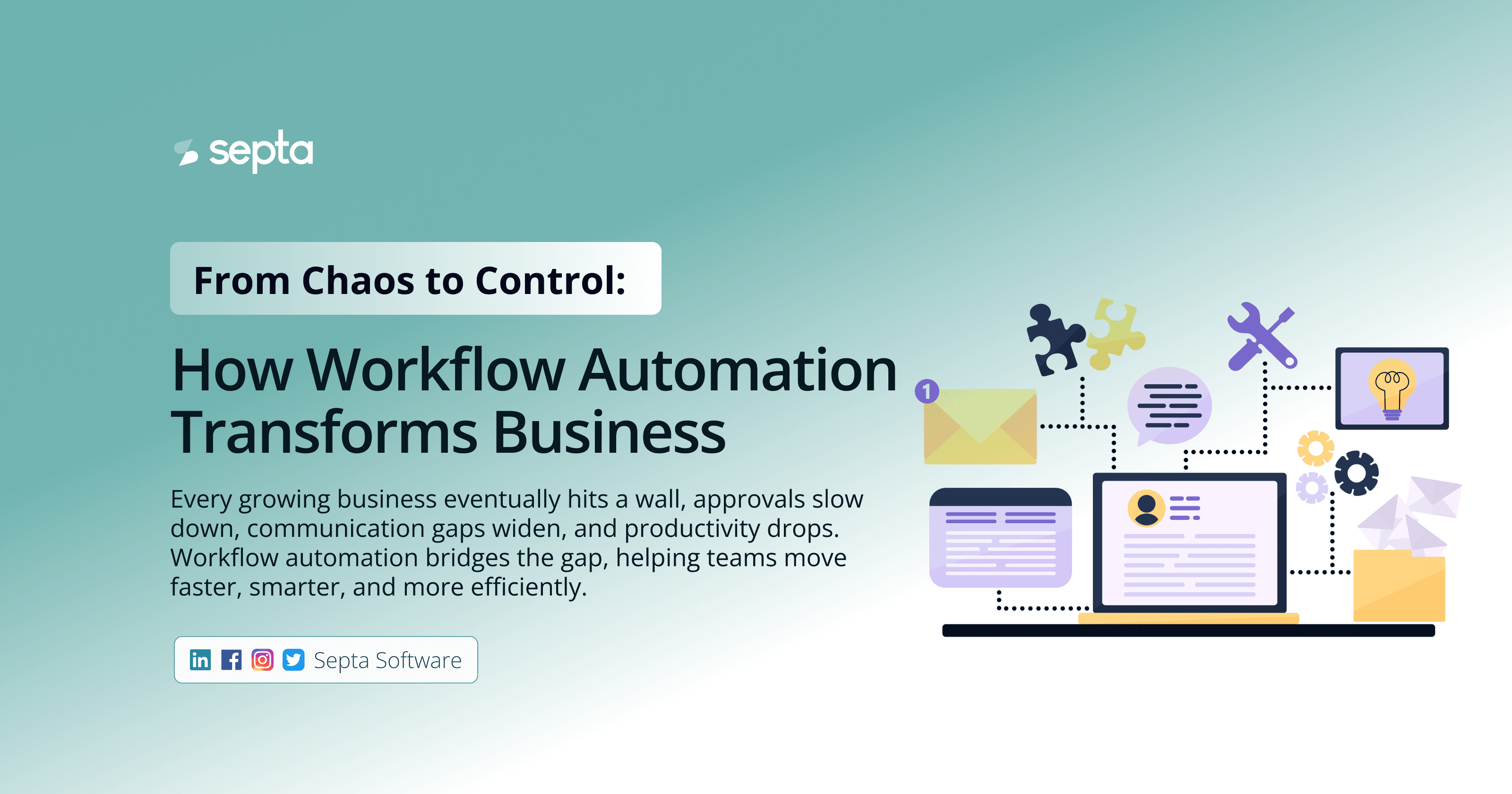
Every growing business eventually hits a wall where manual processes become bottlenecks. Approvals slow down, communication gaps widen, and productivity drops. In a fast-moving world where efficiency defines competitiveness, workflow automation is the difference between chaos and control.
Workflow automation helps businesses streamline repetitive processes, reduce human errors, and save valuable time. By connecting tools, data, and people in one seamless flow, companies can operate faster and smarter without sacrificing quality.
What Is Workflow Automation?
Workflow automation is the use of software and technology to manage and execute routine business processes automatically. It replaces manual effort with predefined rules and triggers, ensuring tasks move smoothly from start to finish.
For example, instead of an employee manually forwarding a document for approval, an automated workflow system routes it instantly to the right person, sends reminders, and tracks completion. In short, workflow automation helps businesses eliminate delays, reduce costs, and improve consistency across every department.
Why Workflow Automation Matters for Business Efficiency
Efficiency isn’t just about speed, it’s about doing the right work, at the right time, with minimal effort. According to McKinsey, more than 60% of all occupations have at least 30% of tasks that can be automated. Yet many organizations still rely heavily on manual systems that slow them down.
Here’s what makes automation so impactful:
Reduces errors: Minimizes mistakes from manual data entry and task duplication.
Boosts productivity: Automates repetitive tasks so teams can focus on strategy.
Increases transparency: Tracks every stage of a process for accountability.
Saves time and cost: Eliminates bottlenecks and optimizes resource use.
Improves employee experience: Frees teams from tedious, repetitive work.
When manual work is automated, your business doesn’t just get faster, it gets more accurate, consistent, and scalable.
Key Areas Where Workflow Automation Delivers Results
Workflow automation can transform nearly every area of business operations. Some of the most impactful use cases include:
Finance and Accounting: Automate invoice processing, expense approvals, and budget reconciliation.
Human Resources: Streamline onboarding, leave requests, and performance reviews.
Operations and Logistics: Track orders, manage supply chains, and ensure process consistency.
Customer Support: AI chatbots handle common inquiries instantly, route tickets automatically, and provide real-time updates by speeding up response times, boosting customer satisfaction, and freeing your team to focus on complex issues.
Sales and Marketing: Manage leads, nurture customer relationships, and track conversions.
These areas see measurable gains in accuracy, speed, and cost savings once automation takes hold.
How to Implement Workflow Automation Effectively
Transitioning from manual to automated processes doesn’t have to be complicated. A strategic, step-by-step approach ensures long-term success.
Here’s how to start:
Identify repetitive tasks: Look for high-frequency, time-consuming activities.
Map existing workflows: Visualize how information and approvals currently move.
Choose the right automation tools: Select platforms that integrate easily with your existing systems.
Set clear KPIs: Measure time saved, error reduction, or cost improvements.
Start small and scale: Begin with one department or workflow, then expand gradually.
Automation isn’t a one-time project; it’s an evolving strategy that grows with your business.
Common Workflow Automation Mistakes to Avoid
Even with the best tools, poor implementation can limit automation success. Avoid these common pitfalls:
Automating unclear processes: Fix inefficient workflows before automating them.
Ignoring employee feedback: Involve end-users early, they know where the real friction points are.
Lack of change management: Provide proper training and communication to ensure adoption.
Not measuring outcomes: Track performance metrics to prove ROI and identify improvement areas.
Successful automation depends on clarity, collaboration, and consistent evaluation.
The Future of Workflow Automation: AI and Beyond
The next evolution of automation goes beyond simple task management. Artificial Intelligence (AI) and machine learning (ML) are enabling systems that not only follow rules but learn from data to make intelligent decisions.
Septa’s AI-powered chatbots illustrate this next wave of automation. They understand customer queries, provide instant responses, and route complex requests to the right teams, all while continuously improving from interactions. Businesses can explore their capabilities through an optional demo, seeing firsthand how AI chatbots streamline support and improve customer experience.
Future-ready organizations will leverage intelligent automation, combining AI, data analytics, workflow optimization, and AI-powered tools like Septa’s chatbots to predict outcomes, adapt processes, and enhance customer experiences in real time.
In short, businesses that adopt AI-driven automation early including AI chatbots gain the agility, efficiency, and resilience needed to thrive in a rapidly changing market.
Final Thoughts
Workflow automation is no longer optional; it’s an essential part of digital transformation. It helps organizations improve efficiency, reduce costs, and empower employees to focus on higher-value work.
Whether you’re a small business automating approvals or an enterprise optimizing complex workflows, every automation step moves you closer to operational excellence. Automation isn’t about replacing people, it’s about empowering them to achieve more.
If your organization is ready to simplify operations and eliminate bottlenecks, Septa Software can help. Our tailored automation solutions, including AI-powered chatbots, are designed to improve efficiency, reduce costs, and give teams the freedom to focus on what truly matters. Organizations can even book a demo to see our solutions in action and experience firsthand how they transform workflows.
Visit www.septasoftware.com to learn more.